The Method

The science behind StudyIn.

StudyIn isn't built around one productivity trick.

Our system combines ideas from learning science and behavioural psychology to solve a simple, yet difficult problem; how to study more effectively.

Remove the distraction → Study → Retrieve → Adapt → Earn → Repeat

  1. 01Remove
  2. 02Study
  3. 03Retrieve
  4. 04Adapt
  5. 05Earn
  6. 06Repeat

Here’s the thinking behind each part.

01

Remove the distraction

It’s easier to focus when the distraction isn’t available.

In a 2025 randomised controlled trial, researchers blocked mobile internet access on participants’ smartphones for two weeks. They found improvements in objectively measured sustained attention, alongside improvements in subjective well-being and mental-health measures.

Another experiment by Ruru Hoong found that people who adopted limits on their phone, Facebook and Instagram use significantly reduced the amount of time they spent using them.

The basic idea is not particularly complicated: removing easy access to a distraction makes it harder for that distraction to interrupt what you intended to do.

But students also use their phones to study. Completely disconnecting is not always practical or the best solution.

StudyIn takes a selective approach. You choose the apps that tend to pull you away from studying, and StudyIn shields those apps during your session while leaving the rest of your phone available.

The aim isn’t to make your phone useless.

It’s to keep TikTok from becoming the most interesting thing on your desk.

Minutes per day

Less mobile internet, less screen time.

In the study, blocking mobile internet roughly halved average daily screen time during the intervention period.

This intervention blocked all mobile internet, not selected apps in the way StudyIn does.

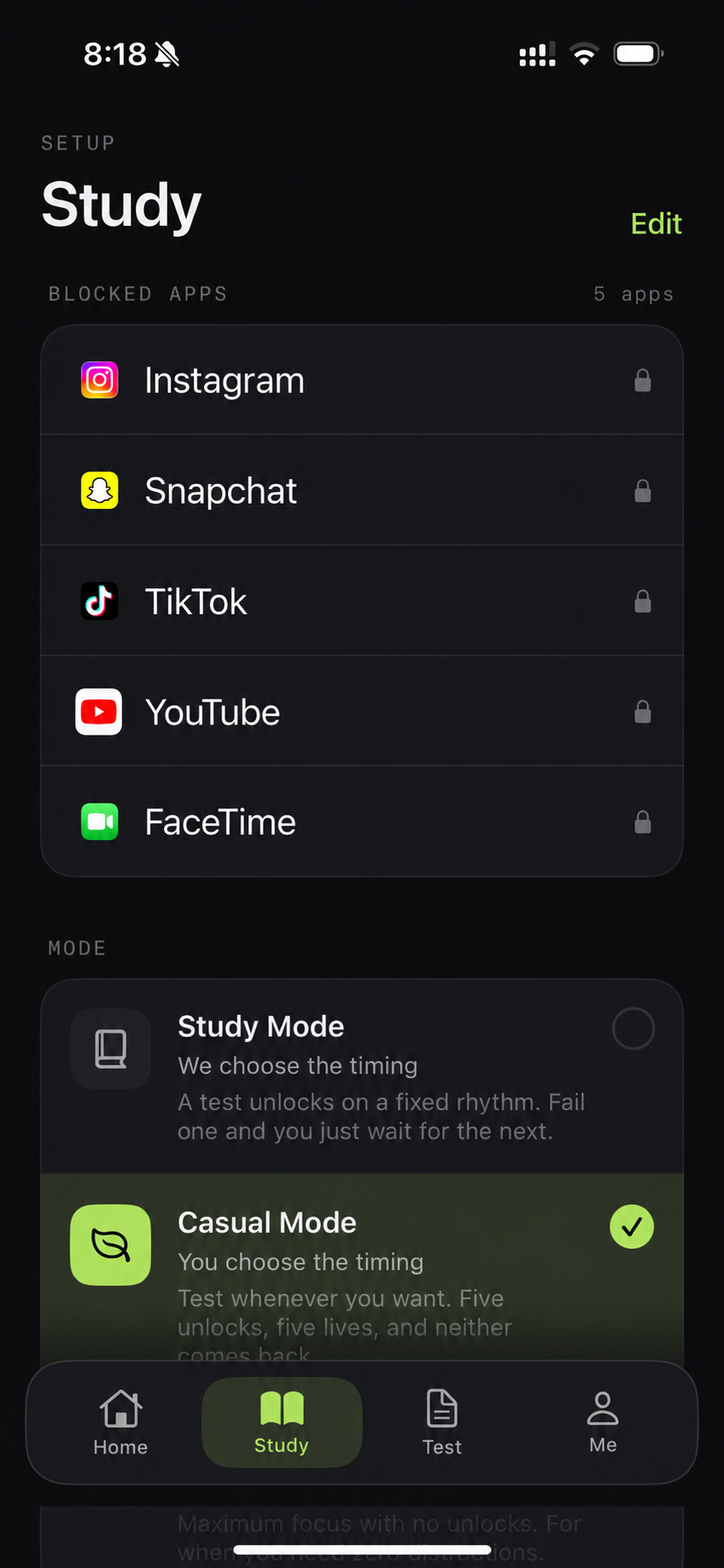
StudyIn screen showing selected distracting apps ready to be shielded
Shield the distractions. Keep the useful parts of your phone.

02

Retrieve, don’t just reread

Being asked is part of the studying.

Rereading and highlighting notes can make material feel familiar. The problem is that familiarity can be mistaken for understanding. Seeing an answer and being able to produce it yourself are not the same thing.

Retrieval practice works differently.

Instead of seeing the information again, you have to pull it back out of memory.

In a well-known 2006 study, Roediger and Karpicke compared repeated studying with repeated testing. Rereading performed better when students were tested almost immediately. But when the test came days later, students who had practised retrieving the information remembered substantially more.

Karpicke and Blunt later found that retrieval practice also produced greater gains in meaningful learning than elaborative study using concept maps.

That is why StudyIn uses a quiz as the unlock.

After studying, you answer questions from the syllabus you have been working on. You are not simply being asked whether you studied. You have to retrieve some of what you were supposed to learn.

So the quiz is not just a barrier between you and your apps.

The quiz is part of the studying.

RereadFamiliarity
RetrieveRecall
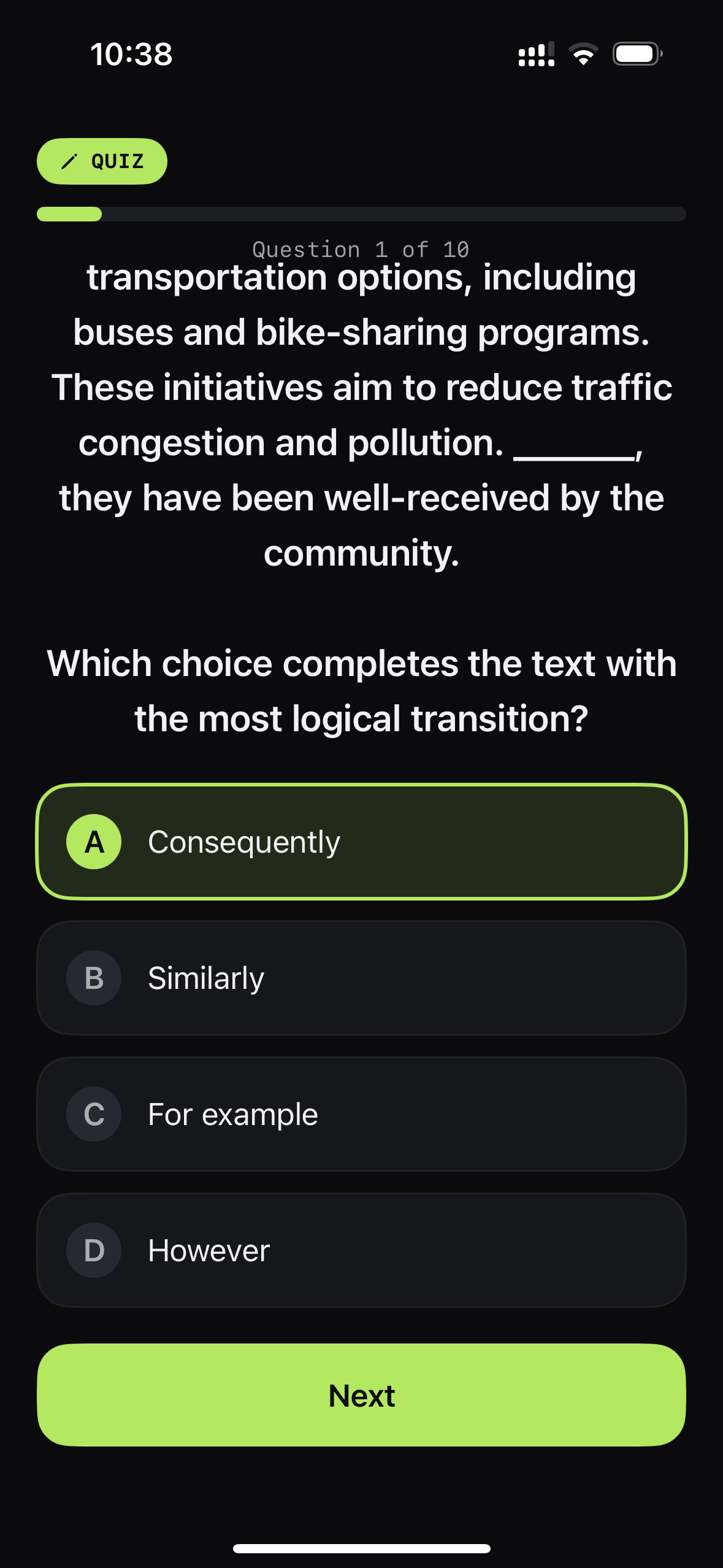
StudyIn syllabus quiz asking a multiple-choice exam question
Retrieval is the gate—and part of the practice.

Approximate percentage recalled

Testing wins when memory has to last.

Rereading can feel stronger immediately. Retrieval practice tends to hold up better after time has passed.

Values are adapted and approximate for a clear comparison, not a verbatim reproduction of the paper’s figure.

03

Repeat, Repeat, Repeat

One correct answer doesn’t mean you’ve mastered a subject.

Learning something once and being able to recall it weeks later are two different things.

Research on retrieval practice shows that returning to material across multiple learning sessions can make knowledge more durable.

Rawson and Dunlosky studied repeated retrieval and relearning across spaced intervals. Their results showed that relearning had a substantial effect on longer-term retention, with relatively little additional practice required.

This is why StudyIn does not simply forget about a question once you have seen it.

Questions you struggle with can be resurfaced later, giving you another chance to retrieve the information instead of letting a weak topic disappear into your quiz history.

Get it wrong. Learn it. See it again. Get it right.

The aim is understanding that lasts.

Missed material gets another turn.

1Question appearsTry to retrieve it
2MissedReview and learn
3Returns laterRetrieve it again
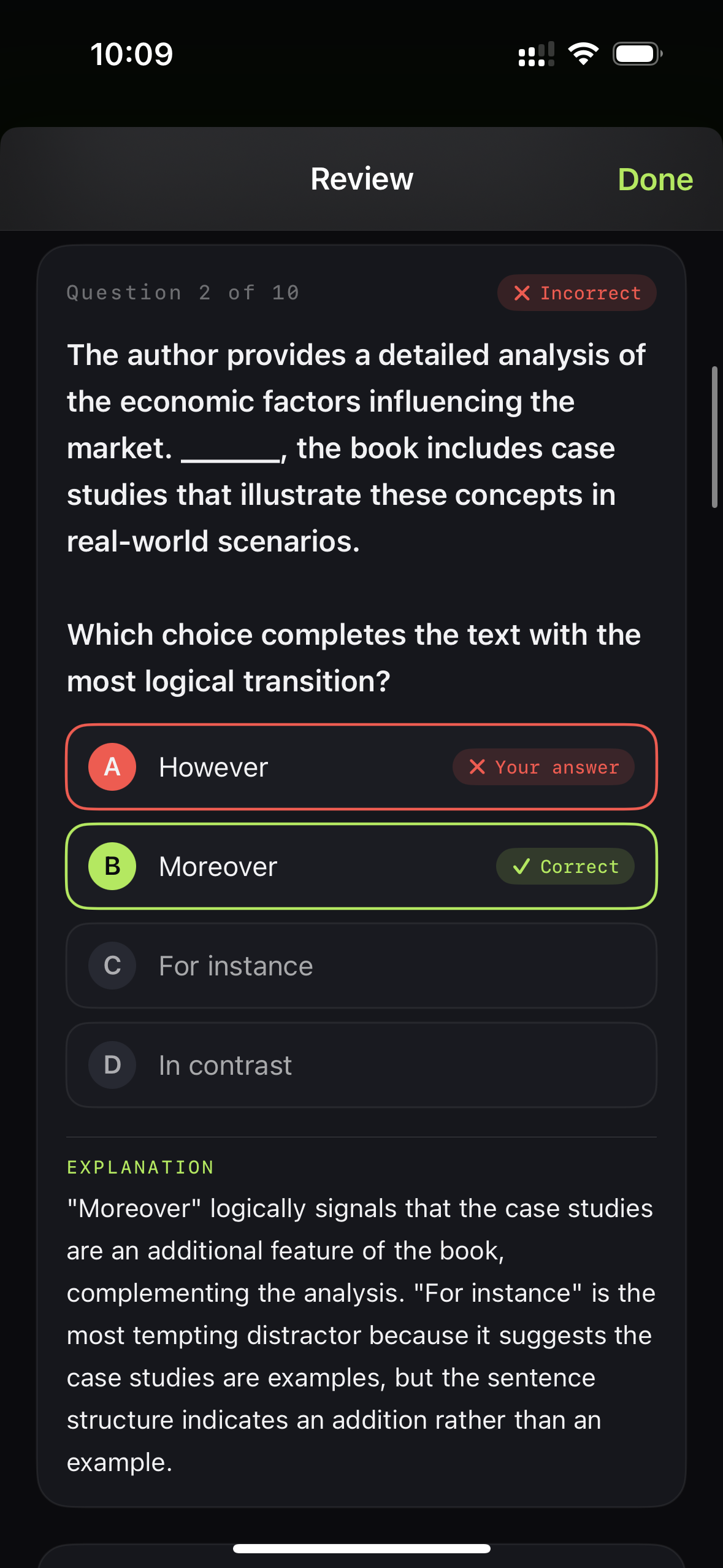
StudyIn quiz result showing that the pass mark was not reached
StudyIn review screen showing an incorrect answer and the correct answer with an explanation

04

Keep it challenging

Practice should make you think. It shouldn’t make success impossible.

Making every question easy would give you a very satisfying mastery score. But it would tell you very little about what you need to improve on.

Simply making every question harder is not the answer either. Research into retrieval difficulty suggests that effortful retrieval can benefit later memory when the retrieval is still successful. Make the task too difficult and those benefits can disappear.

Other research has explored adaptive systems that change practice according to what the learner already knows. In one randomised trial, an adaptive spaced-education system achieved comparable test performance while requiring fewer practice items than a fixed system.

StudyIn applies that principle through adaptive difficulty.

Questions are organised across difficulty levels. Consistently answering questions correctly moves you towards more demanding material. If you struggle, StudyIn keeps questions closer to your current level rather than increasing the difficulty too quickly.

The goal is not to make every quiz harder than the last.

It is to keep the difficulty moving with you, so the questions remain challenging enough to be useful without becoming unrealistic.

Adaptive difficulty

Challenge that moves with you.

  1. Level 4More demanding material
  2. Level 3Current challenge
  3. Level 2Build consistency
  4. Level 1Establish the foundation

Correct consistentlyMove up when you’re ready.

Still strugglingHold steady and keep practising.

05

Make the decision before you want the distraction

Your 7:00pm self and your 7:45pm self want very different things.

Before the start of a study session, staying off Instagram for an hour sounds reasonable.

Forty-five minutes later, when your brain is tired and your phone is beside you, a quick break suddenly sounds more reasonable. And we all know where that can lead.

That is the problem commitment devices are designed to address: make a decision in advance so you do not have to keep making the same decision when temptation arrives.

Hoong’s smartphone experiment found that participants were willing to adopt voluntary limits on their own phone and social-media use, and that those limits reduced subsequent use.

StudyIn uses the same broad idea.

You decide which apps to shield before the session begins. Once you are studying, getting them back is no longer just a matter of opening the app.

It becomes a different question: have I learned enough to pass the quiz?

Instead of asking your future self to keep saying no, StudyIn removes the easy one-tap decision to give yourself another break.

Decide once. Let the system remember.

Before temptation

Choose the apps to shield and start the session.

Decision made
When temptation arrives

Your selected apps stay behind the quiz.

One tap isn’t enough

06

Put the reward on the other side of the work

Vegetables first. Dessert last.

In 1959, psychologist David Premack described a behavioural principle that became known as the Premack Principle.

Put simply: access to something a person is more likely to do can reinforce something they are less likely to do.

It is sometimes called Grandma’s Rule:

Eat your vegetables, then you can have dessert.

Simple in theory. Difficult in practice.

The important part is the reward. It has to be something you genuinely want.

For a lot of students, social media, games and entertainment apps already have that pull. StudyIn uses that existing motivation instead of inventing a points system or another virtual reward.

You choose the apps you want access to. You study. You prove what you learned. Then you earn a window in which those apps are available again.

Study, Quiz, Earn Screen Time

There is a related idea in behavioural economics called temptation bundling. Katherine Milkman and colleagues tested what happened when people could enjoy tempting audiobooks while exercising. Initially, participants given gym-only access to the audiobooks visited the gym considerably more often than the control group.

The underlying idea is this: leverage something you crave to help do the things you know you should do.

Study→Quiz→Screen Time

Relative change versus control

A desired reward can increase a “should-do” behaviour.

Participants given gym-only access to tempting audiobooks visited the gym more often initially than the control group.

The effect declined over time. StudyIn uses a related principle by placing screen time after studying, not during it.

The full system

How it all fits together

None of these ideas exists in isolation inside StudyIn.

They form one cycle.

  1. 01

    Block

    Choose the apps most likely to interrupt your study session.

    Principle: Reduce easy access to distraction.
  2. 02

    Study

    Spend a defined period working on the subject you selected.

    Principle: Make the commitment before the temptation arrives.
  3. 03

    Quiz

    Answer questions from the syllabus you were studying.

    Principle: Retrieval practice.
  4. 04

    Adapt

    Your performance helps determine the difficulty of the questions you see.

    Principle: Keep retrieval challenging but achievable.
  5. 05

    Resurface

    Material you struggled with can return in future quizzes.

    Principle: Repeated and spaced retrieval.
  6. 06

    Earn

    Pass and your selected apps open for a timed window.

    Principle: Put a wanted activity on the other side of the work.
  7. 07

    Repeat

    When the break ends, the shield comes back up and the cycle can begin again.

Study → Prove it → Earn your screen → Repeat.

Claim discipline

Structure that makes studying easier.

Let’s be clear: StudyIn is not a magic fix.

It does not guarantee a higher exam score, fix your attention span, or make TikTok and Instagram less interesting. What you do while your apps are blocked is still up to you.

But once you complete a quiz, it becomes fairly obvious what you have or haven't been doing during that time.

StudyIn is built around the individual principles explored in the research above: reducing access to distraction, practising retrieval, revisiting material over time, adapting practice to the learner, making commitments in advance, and using rewards to reinforce behaviour.

The studies referenced on this page did not test StudyIn itself. They support individual principles used in the design of the StudyIn system.

Sources

Research library

Castelo et al. (2025)

Blocking mobile internet on smartphones improves sustained attention, mental health, and subjective well-being.

PNAS Nexus, 4(2), pgaf017

Randomised controlled trial examining the effect of blocking mobile internet access on smartphones.

Read the paper ↗

Hoong (2021)

Self-control and smartphone use: An experimental study of soft commitment devices.

European Economic Review, 140, 103924

Experimental research into voluntary smartphone and social-media limits as commitment devices.

Read the paper ↗

Roediger & Karpicke (2006)

Test-enhanced learning: Taking memory tests improves long-term retention.

Psychological Science, 17(3), 249–255

A foundational study demonstrating the long-term retention benefits of retrieval practice compared with repeated study.

Read the paper ↗

Karpicke & Blunt (2011)

Retrieval practice produces more learning than elaborative studying with concept mapping.

Science, 331(6018), 772–775

Compared retrieval practice with concept mapping and found stronger meaningful-learning outcomes from retrieval.

Read the paper ↗

Rawson & Dunlosky (2011)

Optimizing schedules of retrieval practice for durable and efficient learning: How much is enough?

Journal of Experimental Psychology: General, 140(3), 283–302

Examined how repeated retrieval and relearning across spaced sessions affect durable learning.

Read the paper ↗

Pyc & Rawson (2009)

Testing the retrieval effort hypothesis: Does greater difficulty correctly recalling information lead to higher levels of memory?

Journal of Memory and Language, 60(4), 437–447

Examined whether more effortful—but successful—retrieval produces stronger later memory.

Read the paper ↗

Kerfoot (2010)

Adaptive spaced education improves learning efficiency: A randomized controlled trial.

The Journal of Urology, 183(2), 678–681

Compared adaptive and non-adaptive spaced education and found that the adaptive system achieved comparable learning with fewer practice items.

Read the paper ↗

Fiechter & Benjamin (2019)

Techniques for scaffolding retrieval practice: The costs and benefits of adaptive versus diminishing cues.

Psychonomic Bulletin & Review, 26(5), 1666–1674

Examined an adaptive retrieval system that adjusted retrieval demands according to learner performance.

Read the paper ↗

Premack (1959)

Toward empirical behavior laws: I. Positive reinforcement.

Psychological Review, 66(4), 219–233

Early research underlying the behavioural principle now known as the Premack Principle.

Read the paper ↗

Milkman, Minson & Volpp (2014)

Holding the Hunger Games Hostage at the Gym: An Evaluation of Temptation Bundling.

Management Science, 60(2), 283–299

A field experiment testing whether access to a desirable activity could encourage engagement in a beneficial but less immediately appealing activity.

Read the paper ↗

The method in action

Built for studying. Backed by more than a hunch.

See how StudyIn turns these principles into a study session.